Caring for the Whole Person, Spiritually and Beyond
A First-year Student Explores What it Means to be Catholic in the Classroom and on Campus
By: Jennon Bell Hoffmann
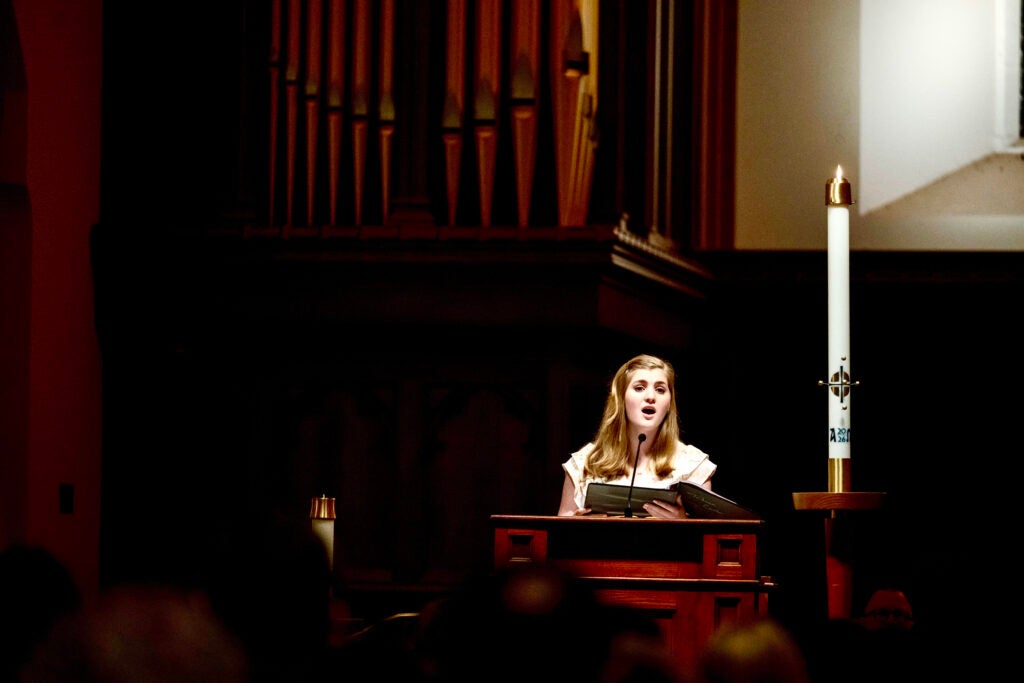
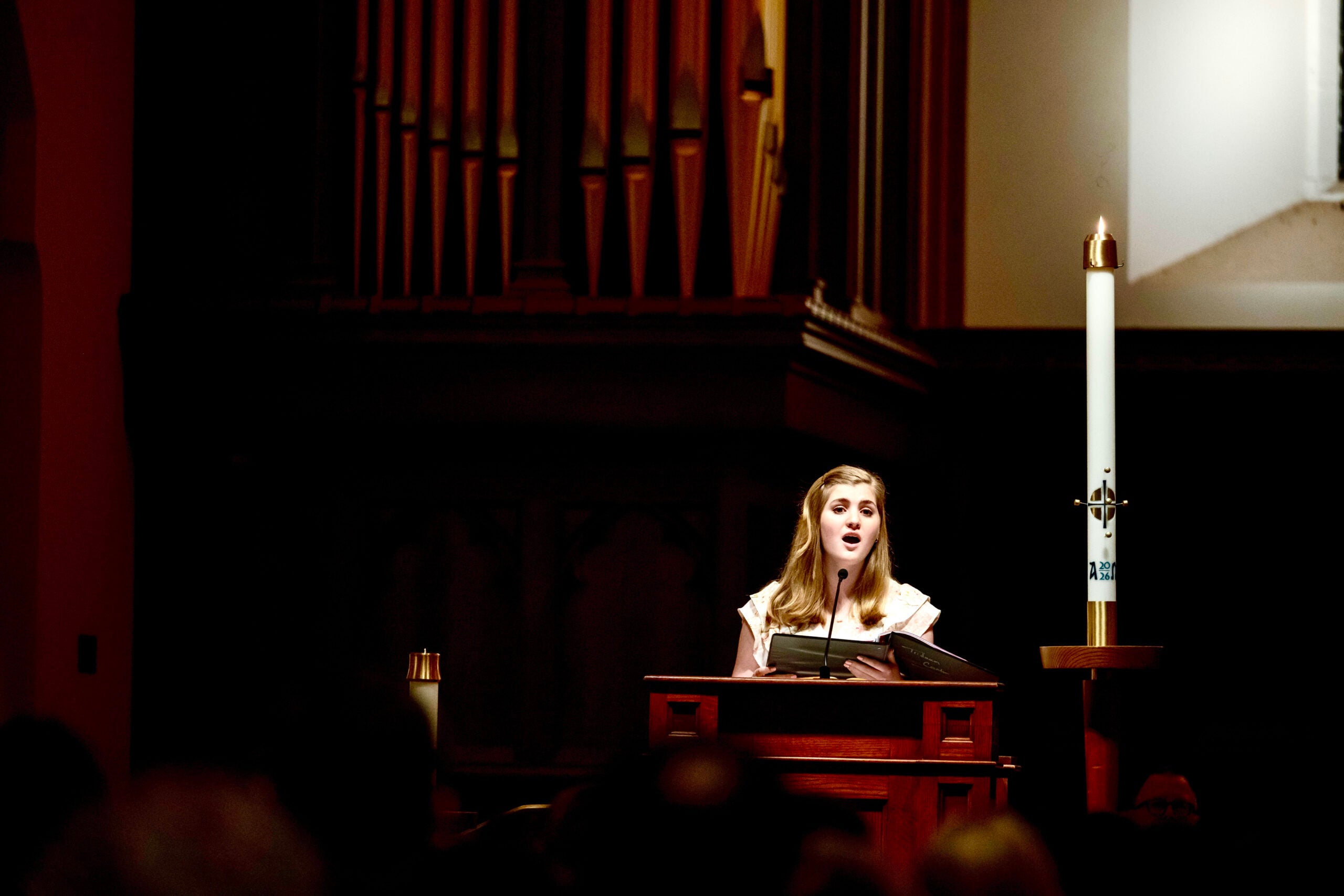
Felicity Kushner (N’29), cantor for the Easter Vigil.
For Felicity Kushner (N’29), Georgetown’s Jesuit identity was never just a line in a brochure. It was one of the reasons she chose the university in the first place. Raised in a large Catholic family in Westerly, Rhode Island, Felicity grew up understanding faith not only as belief, but as a way of caring for people. Her grandparents attended Boston College, another Jesuit institution, so the language and values of Jesuit education were already familiar to her long before she arrived on Georgetown’s campus.
“I was very familiar with Jesuit education,” she said. “So I was excited to be able to experience that for myself.”
Now a first-year nursing student, Felicity sees those values reflected directly in the kind of healthcare professional she hopes to become. One Jesuit principle in particular—cura personalis, or care for the whole person—resonated deeply with her from the start.
“In healthcare, you don’t always have the ability to really look at and take care of a person as a whole,” she explained. “That’s what I really wanted. I’m fortunate to have been able to be here at Georgetown.”
Felicity’s introduction to Georgetown’s Catholic community happened before she officially became a student. While visiting campus as a prospective student, she met Owen Ruggiero, Georgetown’s associate director for liturgy and music ministry. During their conversation, Felicity shared how eager she was to become involved in Catholic life on campus, and Owen’s enthusiasm for the many ways to explore her faith immediately stood out to her.
“His encouragement was so infectious and welcoming,” she recalled. “He told me about Catholic Women and music ministry, Catholic choir, cantoring, and all the ways to be involved. Because of his gracious welcome, I was really inspired to check out all those avenues when I got to campus. That was really my first introduction to Catholic life at Georgetown.”
Looking back, she sees that initial welcome as pivotal.
“You don’t really know anyone your first few days on campus,” she said. “Sometimes it can be hard to find your niche. But my faith immediately gave me something that connected me to other people.”
Among the many communities Felicity discovered at Georgetown, Catholic Women quickly became one of the most formative. Rather than operating through rigid meetings or formal structures, the organization focuses on creating opportunities for connection, reflection, and friendship. Some gatherings are distinctly spiritual, while others are about spending time together and building friendships.
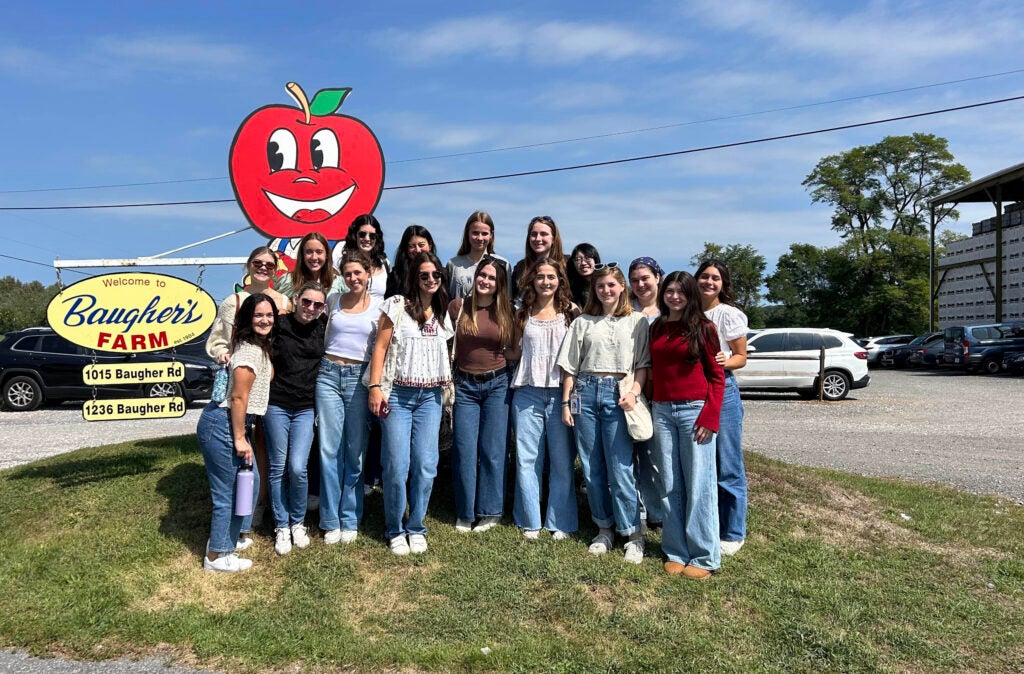
Apple picking with fellow members of Catholic Women at Georgetown. Photo courtesy of Felicity Kushner (N’29).
“It was nice to be part of a religious group that also just does fun things together,” she said. “There’s a really beautiful sisterhood there. And that’s not something I was expecting.”
Her favorite experiences came through the organization’s spiritual discussion dinners. On warm evenings, students gather picnic-style on Healy Lawn to share meals and talk openly about faith, life, and personal struggles.
“Sometimes we’ll talk about specific figures in our faith life, like saints. Other times we’re just reflecting on where we’re at in our faith life,” says Felicity. “It’s just a beautiful space and open opportunity to share what’s going on in your life that maybe you don’t get a chance to talk about anywhere else. It was really formative for me.”
That combination of honesty, friendship, and spiritual reflection became one of the defining parts of her first year.
Retreats, Reflection, and Friendship
Like many Georgetown students, Felicity describes retreats as some of the most impactful experiences of her first year. She attended both the First Year Loyola Retreat and an all-class retreat held at Georgetown’s Calcagnini Contemplative Center.
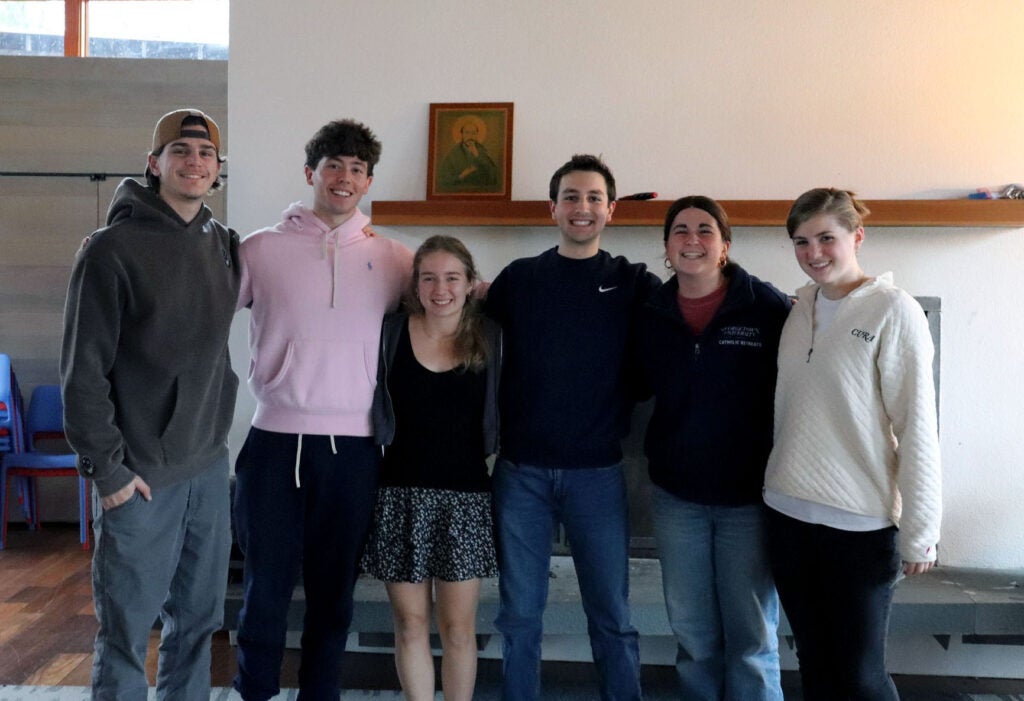
Felicity (first on the right) with fellow Hoyas on the Loyola Retreat at the Calcagnini Contemplative Center.
“It was so much fun,” she said. “There’s a beautiful structure to retreat and a lot of spiritual reflection, but also the right amount of downtime too.”
For nursing students, especially, the chance to pause and reflect can feel essential. As a first-year nursing student, she already works directly in clinical environments. During her internship at MedStar Georgetown University Hospital’s labor and delivery floor, she has already assisted in delivering six babies.
“It’s definitely very involved and fast-paced,” she said. “But you come to Georgetown because you’re studying what you love.”
Her coursework also directly connects Georgetown’s Jesuit mission to patient care. In one class, students discuss what it means to be a “Hoya nurse” and how Jesuit values shape healthcare practice. The conversations often center on how healthcare professionals navigate patients’ personal beliefs, cultural backgrounds, and ethical perspectives while still providing compassionate care.
“[In class] we talk about the intersection between our Jesuit values and nursing,” Felicity explained. “You bring your own perspective to the table, but you also have to acknowledge the other person’s perspective and what the patient wants. We learn how to have those conversations.”

Felicity (on the right) takes a selfie with Claire Brandon (SFS’29) at the 2026 March for Life.
One of the things Felicity values most about Georgetown is the university’s emphasis on interfaith dialogue. Although Georgetown is Catholic and Jesuit, she says faith life on campus never feels restrictive or exclusive. Instead, students are encouraged to engage openly and respectfully with people from different religious traditions.
She first experienced that through Georgetown’s “Problem of God” theology course, where students explore questions about belief through multiple religious perspectives.
“I realized how much I still didn’t know about other faiths,” she said. “I love learning about other religions,” she says. “There is some overlap, and there are also differences, and I’ve really loved talking about that.”
For Felicity, Georgetown models a kind of faith-centered dialogue that feels especially important in today’s conversations and for her chosen profession.
“It teaches you how to have curious, respectful conversations,” she said. “Not conversations where one person is trying to convert the other, but conversations where you’re genuinely interested in learning.”
Recently, one student who identifies as agnostic began attending daily Mass with her friend group simply out of curiosity. Rather than pressuring or overwhelming him, Felicity and her friends simply answered questions and invited conversation.
“It’s not like, ‘This is truth, join us.’ It’s more about letting people lead with their curiosity. As Catholics, we still have questions too,” she said. “Seeing someone else’s curiosity reminds you of that.”
When Felicity reflects on her first year at Georgetown, what stands out most is not any single event or organization. It is the feeling of rootedness she found through Catholic life—in choir rehearsals, retreats, service opportunities, and quiet conversations on Healy Lawn.
As she continues toward a future in nursing, she sees those experiences preparing her not only academically, but personally and spiritually as well—through music, service, dialogue, friendship, and the continual effort to care for people for the whole person, fully and compassionately.
Jennon Bell Hoffmann is a freelance writer and editor living in Chicago.
- Tagged
- Catholic