Building Trust with Patience, for Patients
A recent alumna on how her academic training shaped her approach to interfaith engagement at Georgetown
By Claire Auslander (N’26)
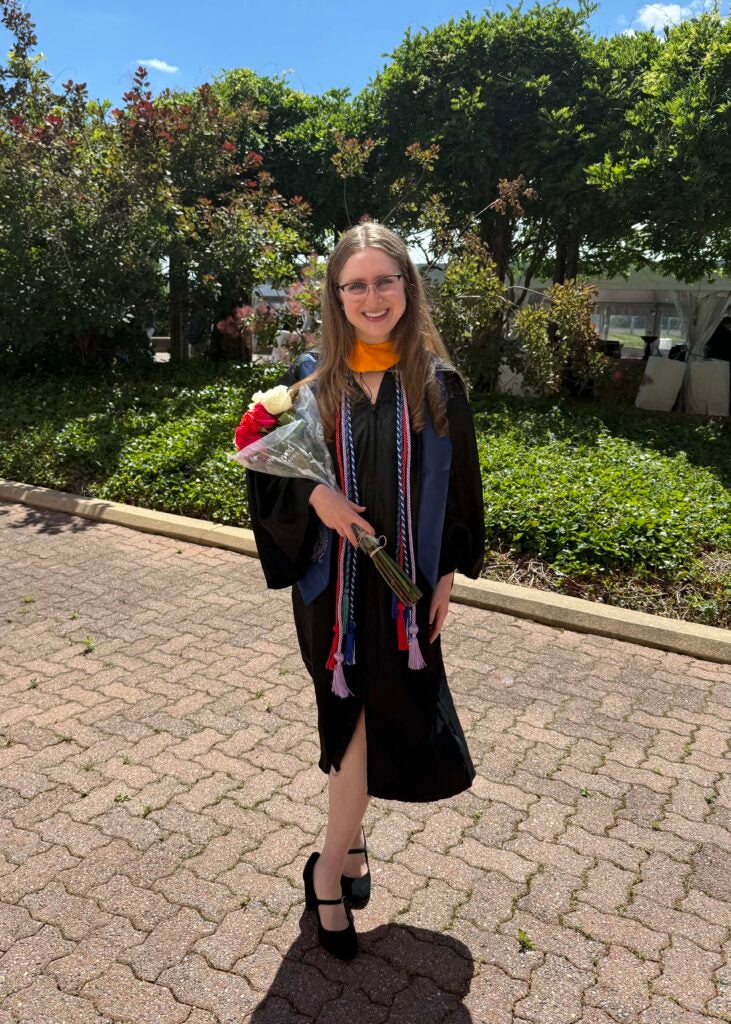
Claire Auslander (N’26)
When I first began my journey in interfaith leadership at Georgetown, I understood interfaith dialogue primarily as facilitating respectful conversations across lines of difference. I did not anticipate how deeply this work would intersect with—and ultimately transform—my development as a nursing student as well.
As a student nurse, I have had the privilege of caring for patients during their most vulnerable moments. Supporting families on the best and worst days of their lives, I began to understand that excellent care required not only a breadth of clinical knowledge but also the ability to create a supportive, therapeutic environment. I began to see that the greatest gift I could offer my patients was that of accompaniment.
I brought that same orientation to supporting our interfaith community back on campus. During interfaith retreats and dialogue programs, I noticed how many students arrived prepared to explain themselves and their grief. They entered conversations with apprehension, carrying fears of being misunderstood or called to answer for their entire tradition.
Over time, I realized that the same posture that built trust at the bedside also built trust in interfaith communities. Interfaith engagement is not simply about recognizing difference; it is about allowing another person’s story to reshape the way you understand your own. It requires vulnerability as much as curiosity. It asks you not only to speak honestly about what you believe, but to trust someone else enough to let them witness the parts of yourself that are still uncertain. I stopped seeing dialogue as an exercise in finding the right language. Instead, it emerged as an act of accompaniment: creating conditions where people feel safe enough to share these deeply personal parts of themselves and know they will be met with love and care.
My interfaith engagement, in turn, deepened my clinical education. With each patient I was fortunate to accompany, I became increasingly aware of how faith, culture, and identity shaped their perspective on health and healing. Rather than approaching clinical encounters solely through a biomedical framework, I learned to attend to the meanings patients ascribed to their experiences and the values that informed their decisions. I became more intentional about understanding the histories, relationships, beliefs, and communities that each person brought into the clinical setting. In the end, my most meaningful moments at the bedside and with Campus Ministry were held in the tremendous gift of accompaniment through moments of uncertainty, grief, vulnerability, and joy.
I would like to thank the entire Georgetown Office of Campus Ministry team, in particular my incredible mentors Aaron Johnson, Michael Haycock, Rabbi Ilana Zeitman, and Deb Silver. And of course, to every student whom I had the pleasure of meeting and building community with over each retreat, dinner, board meeting, event, and conversation—thank you for the invitation to share in each other’s traditions.
- Tagged
- Alum
- Interfaith
- Jewish