Building a Community Through Trust and Understanding
A recent graduate reflects on interfaith engagement at Georgetown
By Saara Bidiwala (C’26)
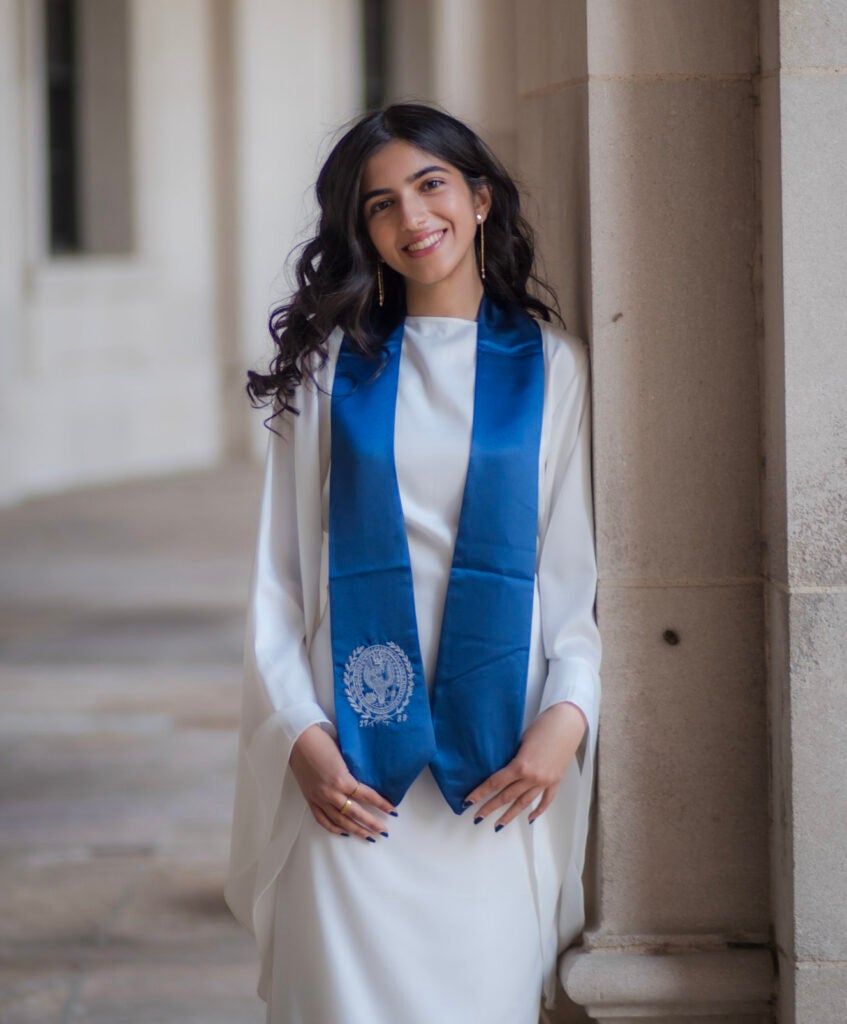
Saara Bidiwala (C’26)
When I first visited Georgetown in 11th grade, I saw two banners regularly: one read “Cura Personalis” and the other “Interreligious Understanding.” Intrigued by these words, I learned through my research that cura personalis meant caring for the whole person. Growing up, I always knew I wanted to be a doctor, but I had no idea the immense impact those words would have on my personal and professional journey on the Hilltop.
There were so many times where I, as a Muslim-American in a post-9/11 world, felt misunderstood. In high school, I organized interfaith community events as the president of the Muslim Students Association after a tragedy occurred in my hometown. Seeing leading figures from my local Muslim community, like Imam Omar Suleiman, rally around other faith communities in light of this event was a big inspiration for me.
In my hometown, armed groups would circle our mosque, or one week we’d find out our mosque had lost funding for our Muslim Girl Scout troop. I’m writing this the same week that two armed terrorists entered a masjid in our country and killed three people. I know that similar tragedies have occurred at houses of worship for other communities and in other countries as well. Thus, organizing these events was my way of giving communities a chance to ask each other questions and learn about one another. I often thought that if someone had met a Muslim, Hindu, Jewish, Jain or Sikh person before, maybe they’d understand that we’re more alike than not. Maybe people would not resort to violence to express unfounded fear or hatred. Maybe we wouldn’t need to have several armed guards at our houses of worship anymore. As Muslims, we are obliged to live by the Islamic values of compassion, justice, and love for thy neighbor. And that is what drives me to do this work, even when it becomes challenging.
For similar reasons, I’ve always felt drawn to a career in global healthcare. What I learned after working in healthcare for a few years was that my faith and interfaith work are directly related to how I care for my patients. Healthcare workers are more than just providers of care—the best ones are advocates for their patients, especially in the face of injustice. Beyond what I’ve learned about science in Reiss Building classrooms, I’ve learned through volunteering at clinics serving refugees and immigrants that our ability to actively understand a patient’s cultural and religious background directly impacts their trust in us. Making a patient—especially when they’re in a lot of pain–feel comfortable in a vulnerable setting is of the utmost importance. Sometimes that has looked like interpreting in a patient’s mother tongue of French or Chinese, and other times it is giving a woman practicing modesty for religious reasons more privacy or adjusting her head covering for her. My work in interfaith spaces has significantly improved my understanding of other cultures and faith traditions in healthcare settings.
The experiences I’ve had working with the Georgetown interfaith community since my freshman year have come at a time of profound grief and tragedy from global events in several regions. I think back to the time when members of MSA, JSA, and HSA were planning a service event that was supposed to take place the week after October 7, 2023. This was a period of intense grief, sadness, and frustration for our community. Though we considered cancelling in light of this, in the end we decided to still hold the event because of our shared commitment to serving the interfaith community. Since then, we have established a yearly tradition of interfaith basketball tournaments and other service events. After serving as president of CMSF and as an interfaith engagement intern, I, alongside my friend Claire, have carried forward these events and started doing monthly interfaith community dinners. These have provided participants with the same opportunities to ask each other questions over a meal.
What I have learned from these experiences is that it is very important to acknowledge the heavy pain and grief that can inform people’s hesitation to have dialogue. Only when all parties have mutual respect, willingness, and understanding of differing backgrounds can a productive dialogue occur. Dialogue should never be forced. At the same time, I have witnessed the transformative power of being a bridge to other communities when walls seem to stand between them. My most meaningful memories from this work are not of resolving disagreements, but rather of witnessing others see the humanity in each person. These experiences have given me hope that genuine relationships, built through compassion and trust, can foster understanding across differences and lay the foundation for a more peaceful world, one conversation at a time.
I am forever grateful to have been able to do this work alongside so many amazing friends and mentors, including Imam Yahya Hendi, Aaron Johnson, and Michael Haycock. I know that the lessons and memories I have gained from this work will stay with me beyond my time at the Hilltop and, hopefully, one day as a physician.
The MSA, JSA, and HSA are the Muslim Student Association, the Jewish Student Association, and the Hindu Student Association.
- Tagged
- Alum
- Interfaith
- Muslim