Finding Faith at a Jesuit Institution
Muslim students learn that faith is not an afterthought at Georgetown
By: Jennon Bell Hoffmann
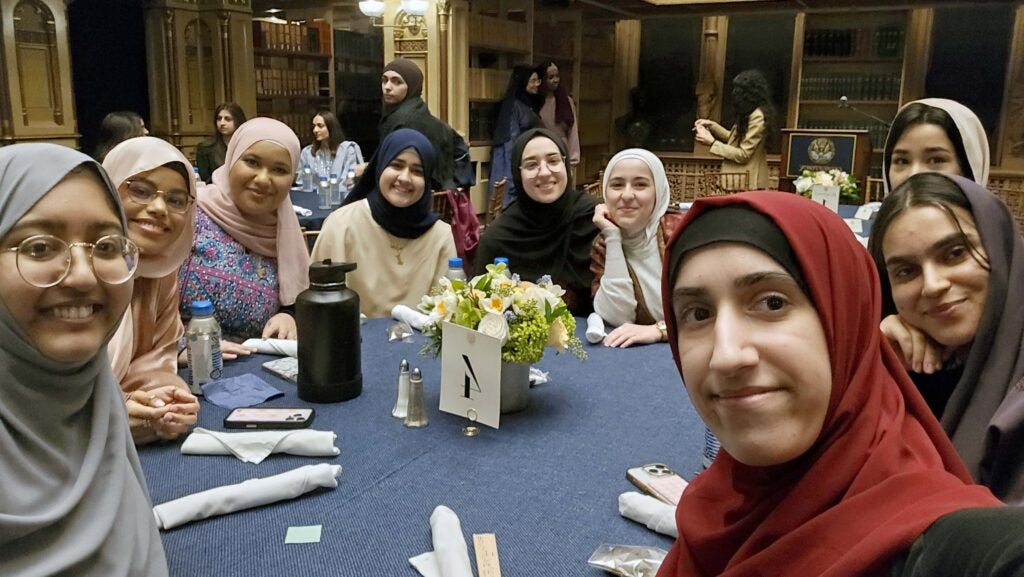
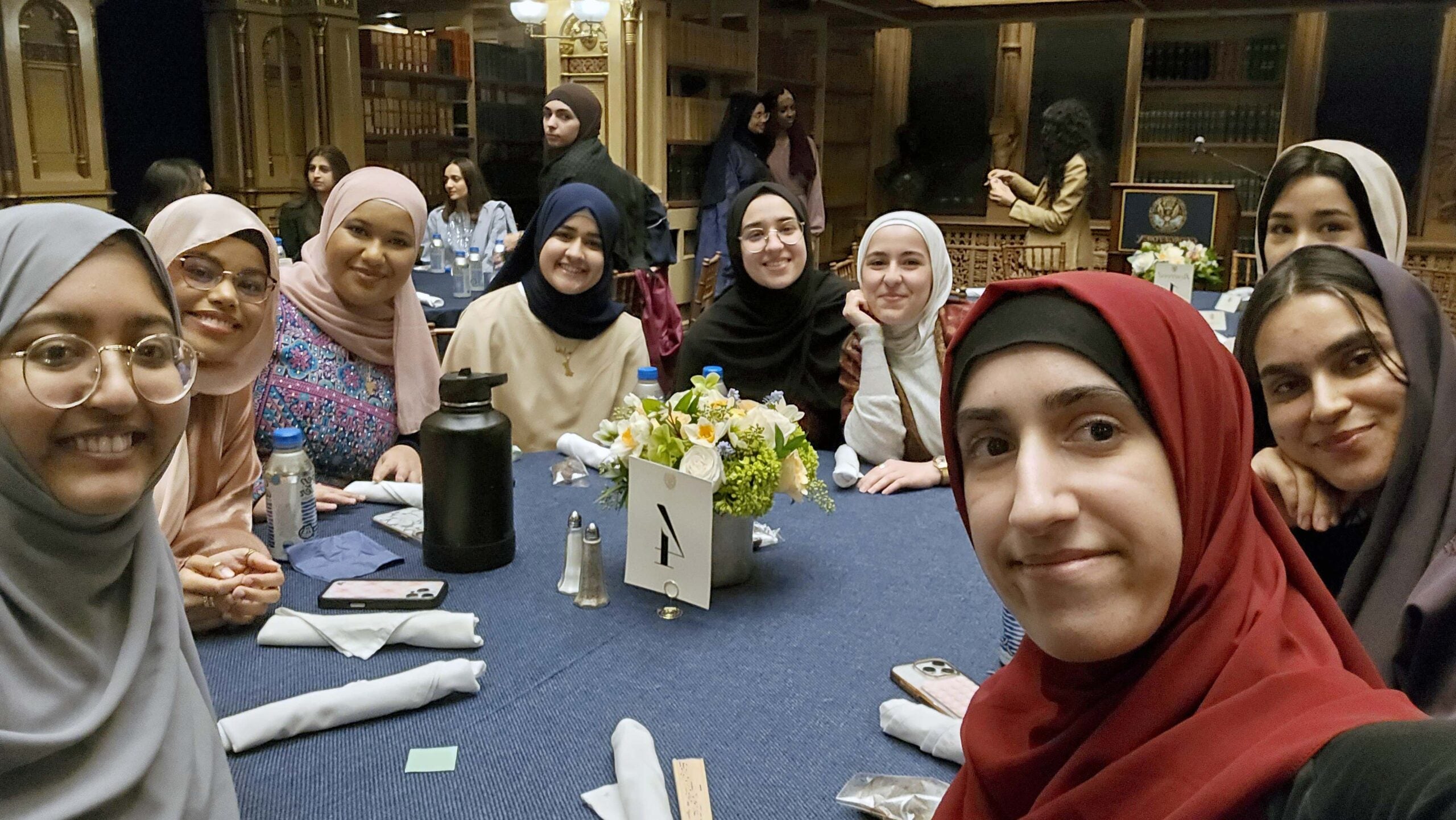
Second from left, Reem Kirja (SFS’29) sits with fellow Hoyas during the President’s Iftar in February.
At Georgetown University, faith is not an afterthought. While it is built around Jesuit values, Campus Ministry strives to make sure that every student, regardless of faith, background, and interest, has a safe and supported space to explore their whole selves.
Four years ago, Maryam Arastu (C’26) arrived from Oklahoma searching for more than strong academics. As a practicing Muslim, she wanted a university where she could grow spiritually while engaging meaningfully with people of other faith traditions.
“When I was looking at Georgetown’s website, I was really happy to see that not only is there a chaplain, Imam Hendi, but also regular programming for the Muslim community, a mosque where we can have prayer services regularly, and more everyday things, like accommodations, Halal dining options, religious housing accommodations and more,” says Maryam.
Reem Kirja (SFS’29), a first-year student, similarly had initial hesitations. Ethnically Sudanese-Egyptian and raised in Iowa, she had experienced what it felt like to stand out because of her faith.
“I found out about the Catholic aspect after [I applied] and was a little worried about it because I didn’t want my religion to be an afterthought or a target on my back like usual,” says Reem. “But coming to Georgetown and seeing the integration of different religions and seeing how each one is valued in its own capacity pleasantly surprised me, and I’m really glad that I was able to make this choice.
Muslim Life and MSA: A Shared Mission
Upon arriving at Georgetown, Maryam’s first introduction to the Muslim community was during a freshman orientation Friday prayer. There she met new friends and was also introduced to the Muslim Student Association (MSA), the student organization under Campus Ministry Student Forum. MSA and Muslim Life (the chaplaincy branch within Campus Ministry) work closely together to provide services, resources, and support for students of any denomination
“That initial encounter was such a warm and welcoming space. Then throughout my freshman year, I really came to find that the Muslim community at Georgetown was my home away from home,” says Maryam. “That experience inspired me to get involved in both MSA and Muslim Life.”
For the MSA and Muslim Life, community-building is intentional. From welcome-back barbecues—where Imam Hendi grills for students—to mentorship initiatives like MSA’s “Big-Little” program, upperclassmen guide new students through both campus life and faith exploration.
Maryam, who served as MSA president last year, helped organize interfaith trivia nights and service projects with other religious student groups to foster a strong and supportive interfaith community at Georgetown.
“MSA has done a lot of social events and things that bring our communities together for the common good, like service projects,” says Maryam. “I feel that drawing on our shared religious values of generosity and kindness and people for others, as well as our common experiences as college students at Georgetown, has been a great way to enrich those relationships.”
Reem was initially hesitant about joining the Muslim community at Georgetown because her previous experience in a home community emphasized a more fear-focused understanding of Allah (SAW), and she was unsure whether she would find a sense of belonging. What she encountered reshaped her understanding of faith.
“I wasn’t really interested in being involved in the Muslim community, but I remember there was a first-year dinner that Imam Hendi held at the masjid with Muslim Life, and my mom convinced me to go at the last minute. She was like, ‘You should just go and check it out. I think you’ll like it,” says Reem. “The way that Allah (SAW) was framed as this merciful being, this being that loves you wholeheartedly [was a] huge difference to what I knew back home. It got me more involved in my religion and actually strengthened my deen.”
Reem, already active as a Doyle Dialogue Fellow, participates in weekly interfaith discussions facilitated by leaders from Muslim and Jewish communities. Watching Muslim and Jewish mentors model thoughtful conversation amid global tensions has been deeply meaningful.
“Especially with everything that’s going on globally, being able to see Jewish individuals and Muslim individuals bridge their differences and come together to speak about how to have that dialogue and how to set up those peace talks is very inspiring for me,” she says.
Both students emphasize that the community meets individuals wherever they are in their spiritual journey. Whether someone arrives deeply observant, questioning, or simply curious, there is room to grow.
The Guiding Light
A big part of the open and welcoming nature of Muslim Life and the Muslim community on Georgetown’s campus is Imam Hendi, Director for Muslim Life. Imam Hendi’s impact is perhaps best measured in the community he nurtures—one where students feel both challenged and supported. When Maryam and Reem speak about Imam Hendi, they cannot help but smile.
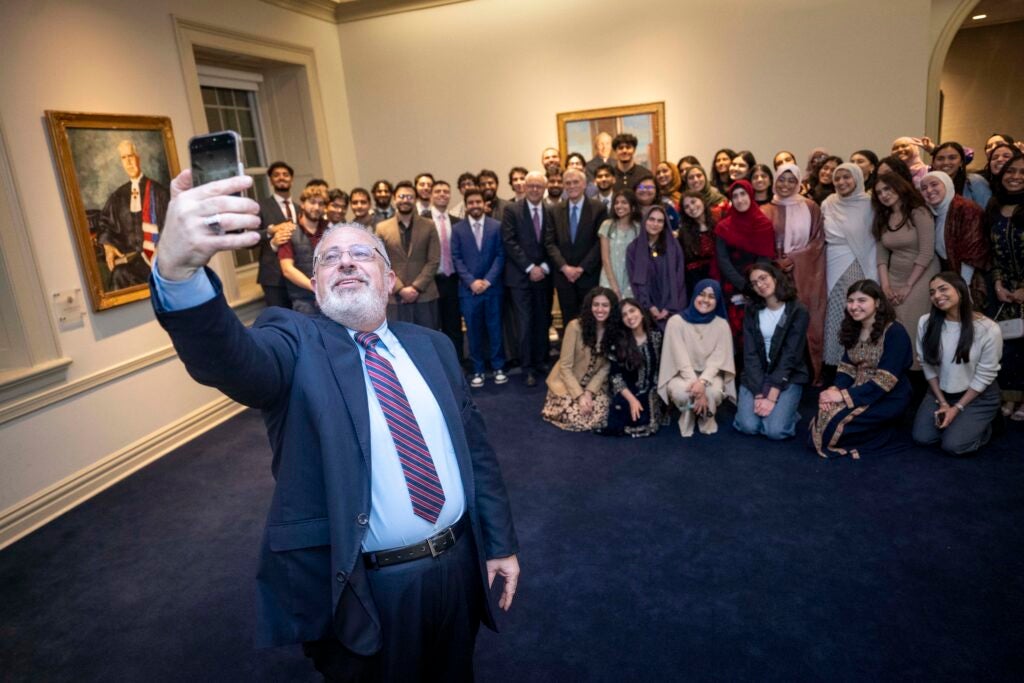
Imam Yahya Hendi, Director for Muslim Life, takes a selfie at the President’s Iftar. Behind him, members of the Georgetown Muslim community are joined by Joe Ferrara, Senior Vice President and Chief of Staff, and Interim President Robert Groves.
“Imam Hendi is like a guiding star; he shines so brightly, allowing us to see the right path,” says Reem. “He creates a perfect balance in the mosque for both faith and friendship, where we can dive deeper into those social interactions while reminding us of our duty as Muslims and about how to carry our faith daily.”
Maryam describes being in his office and watching him invite passersby inside for conversation, food, or simply a warm greeting. “He’s such a welcoming figure, and he’s always there to listen to your challenges, to share a wise word of advice or a prayer, and he’ll almost always offer you a sweet treat or a couch to cry on if needed,” says Maryam. “That generosity and warmth is something I aspire to have.”
Every Friday prayer concludes with a simple but powerful tradition: visitors are invited to introduce themselves. Classmates, parents, alumni, and community members regularly attend. The moment reflects what both students describe as the heart of Muslim Life—openness.
“That’s one of my favorite parts about every week, because you always see new people coming in from so many different backgrounds,” says Maryam. “It’s so beautiful to see the diversity and to see how open the community is.”
Ramadan: A Campus-Wide Invitation
During Ramadan, the holiest month in Islam, that sense of belonging intensifies. Students fast together, gather nightly for iftar dinners, and attend special evening prayers. The month becomes a time of reflection, solidarity, and shared purpose—not only among Muslims but across campus.
Maryam describes Ramadan at Georgetown as the highlight of her year. “It’s a time of community, self-reflection, and spiritual groundedness,” she says. “I think what I’ve learned over the course of these four years here is that it’s really such a blessed time, and it’s not just for the Muslim community. We really make an effort to bring all of Georgetown into it.”
In past years, Muslim Life has hosted campus-wide fasts, inviting non-Muslims to participate in whatever way feels meaningful to them. Friends from other faith traditions frequently attend iftars and Friday prayers.
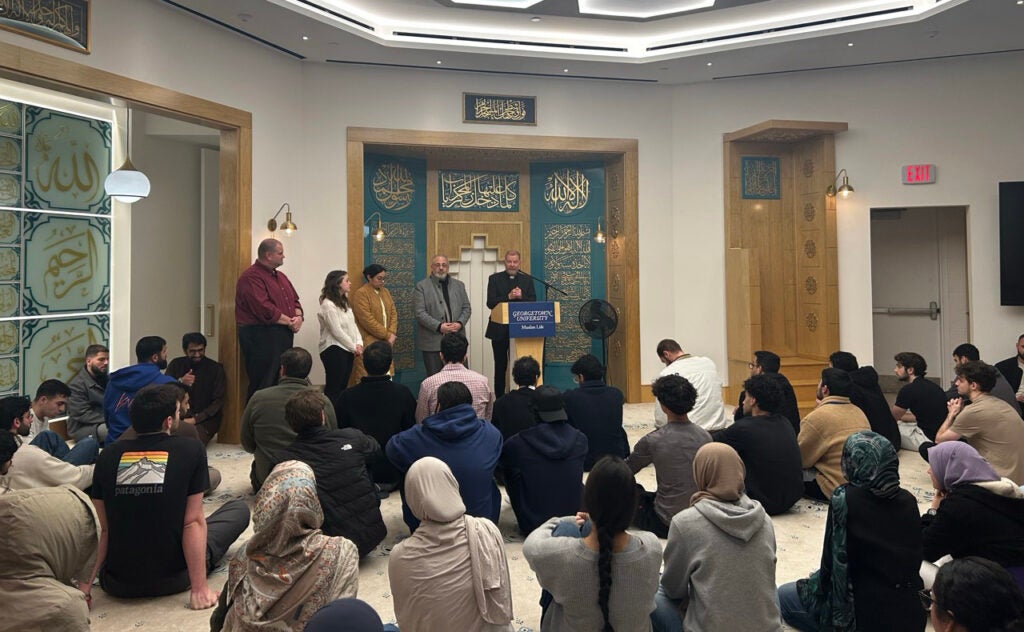
Second from right, Imam Yahya Hendi joins fellow chaplains in addressing the Georgetown Muslim community at an interfaith iftar.
For Reem, Ramadan provides something rare in college life: intentional slowing down.
“Georgetown moves fast; everything is centered on productivity,” she says. “Ramadan creates space to remind you to slow down, to reflect and reconnect with what really matters. That’s something that I really appreciate.”
With the academic year entering the final few months, both Maryam and Reem offered advice to prospective Hoyas wondering whether there is a place for them.
“Whether you’re deeply connected to your faith or still figuring it out, there’s room for sincerity, for learning, and most importantly, there’s room for people to just show up,” says Reem. “And that’s the kind of environment that has made a big difference for me, especially as a first year.”
Maryam echoes the sentiment: “Come just as you are, there is a place for you in the Georgetown community,” says Maryam. “Our doors are always open. Before you know it, you just might find yourself having a second home here.”
Maryam Arastu is a senior in the College of Arts and Sciences, double-majoring in Arabic and linguistics.
Reem Kirja is a first-year student studying international politics with a minor in regional and comparative studies, focusing on the Middle East and North Africa. She is also pre-law.
Jennon Bell Hoffmann is a freelance writer and editor living in Chicago.