Magis Immersion Seminar: Neighbors and Strangers in Poland
A Photo Essay by Avanthika Suryadevara (H‘27) and Ella Montano (C‘28)
Spring 2026 marked the first-ever Neighbors and Strangers: Catholic-Jewish Encounters to Poland, a Magis Immersion Seminar to Poland taught by Professor Anna Sommer from the Center for Jewish Civilization and Rabbi Ilana Zietman, Director for Jewish Life. Alongside 14 of their fellow students, Avanthika Suryadevara (H’27) and Ella Montano (C’28) traveled through Warsaw, Lublin, Oświęcim, Kraków, and many places in between, each stop offering its own story to uncover. Their days consisted of walking tours of former Jewish ghettos, Catholic churches, quiet reflection in museums, and guided visits to concentration and extermination camps. They encountered not only the facts of history, but the weight of it—standing in places where the darkest chapters of human experience unfolded. Yet, in conversations with each other and with members of the Polish community, the students also found moments of connection, resilience, and hope.
In the spirit of conversation and shared experience, Avanthika and Ella, who each come from different faith traditions, collaborated on this photo essay to capture what they saw, felt, and what they are still learning to carry.
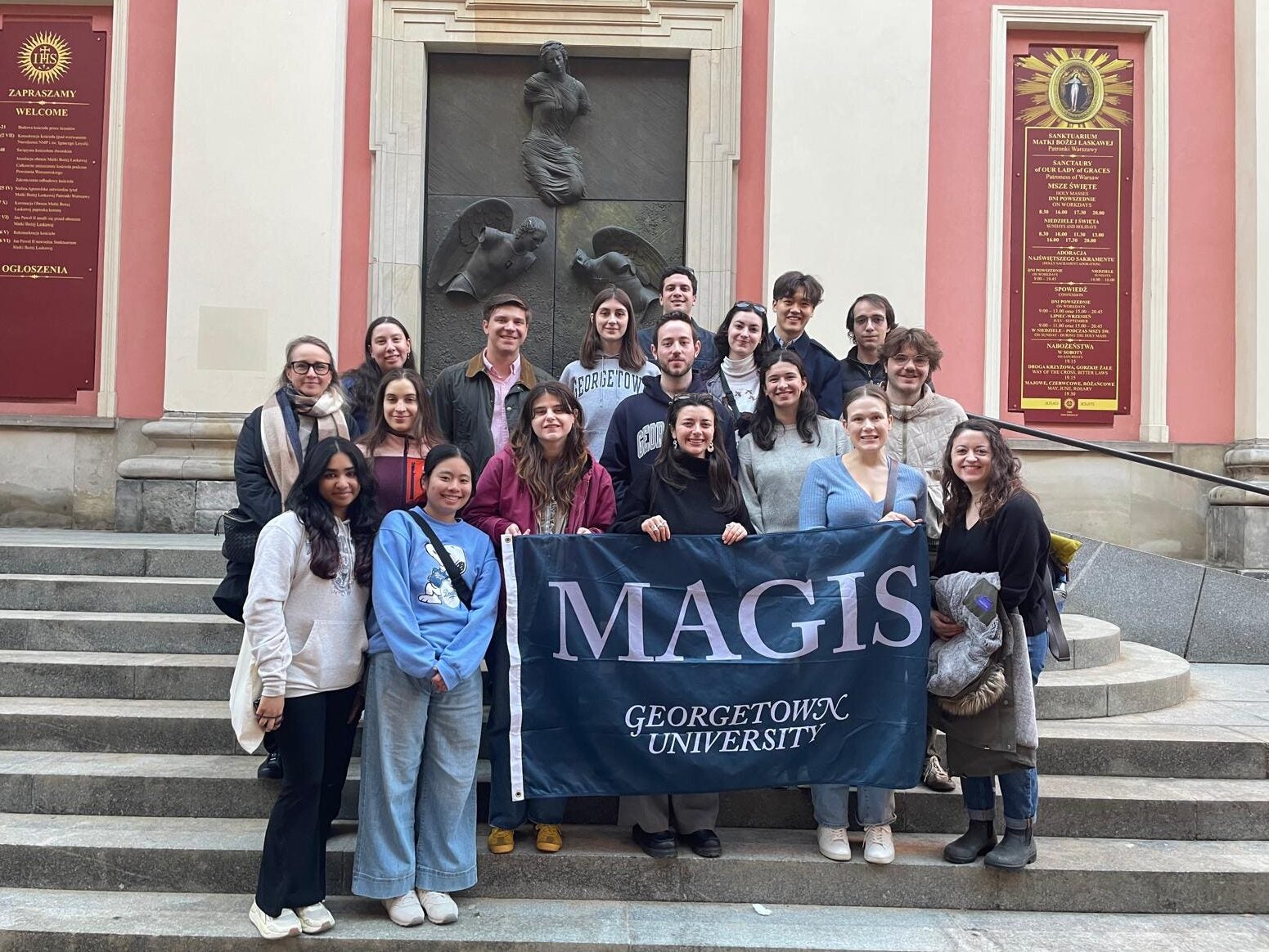
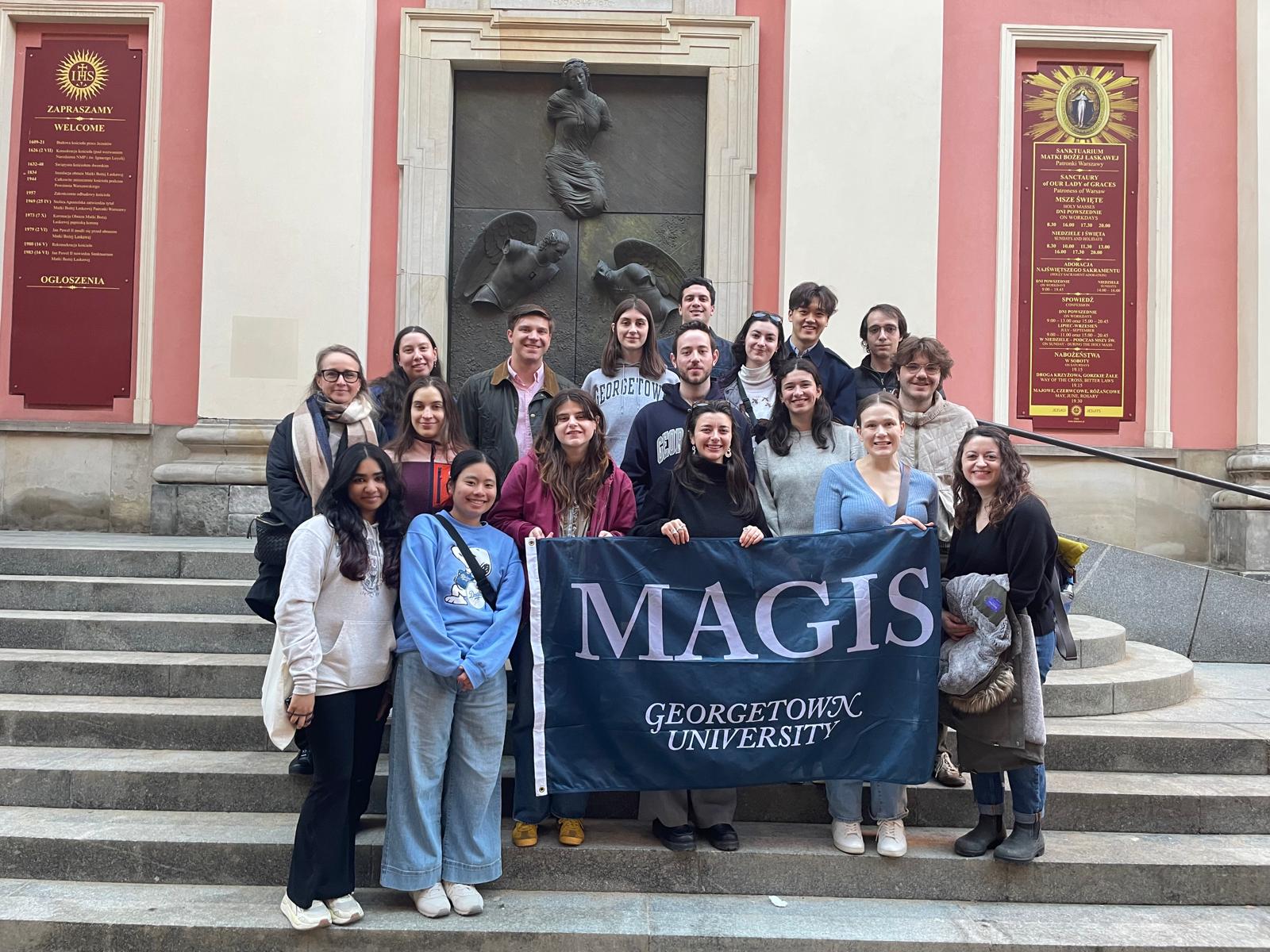
Our class outside the Jesuit Church in Warsaw Old Town on our very first day in Poland.
Avanthika: Our cohort of 16 was diverse in faiths, including Christian, Jewish, and Hindu, as well as in backgrounds, majors, and home countries. I was grateful for this mix because each conversation brought a range of perspectives that challenged my assumptions and broadened my understanding of the world.
Ella: While just getting to know each other at the beginning of the trip, the class really came together to share ideas and be incredibly honest in personal reflections. Being able to see students from such different places brought a unique perspective that was inspiring. This not only deepened my understanding of my classmates but also allowed me to grow.
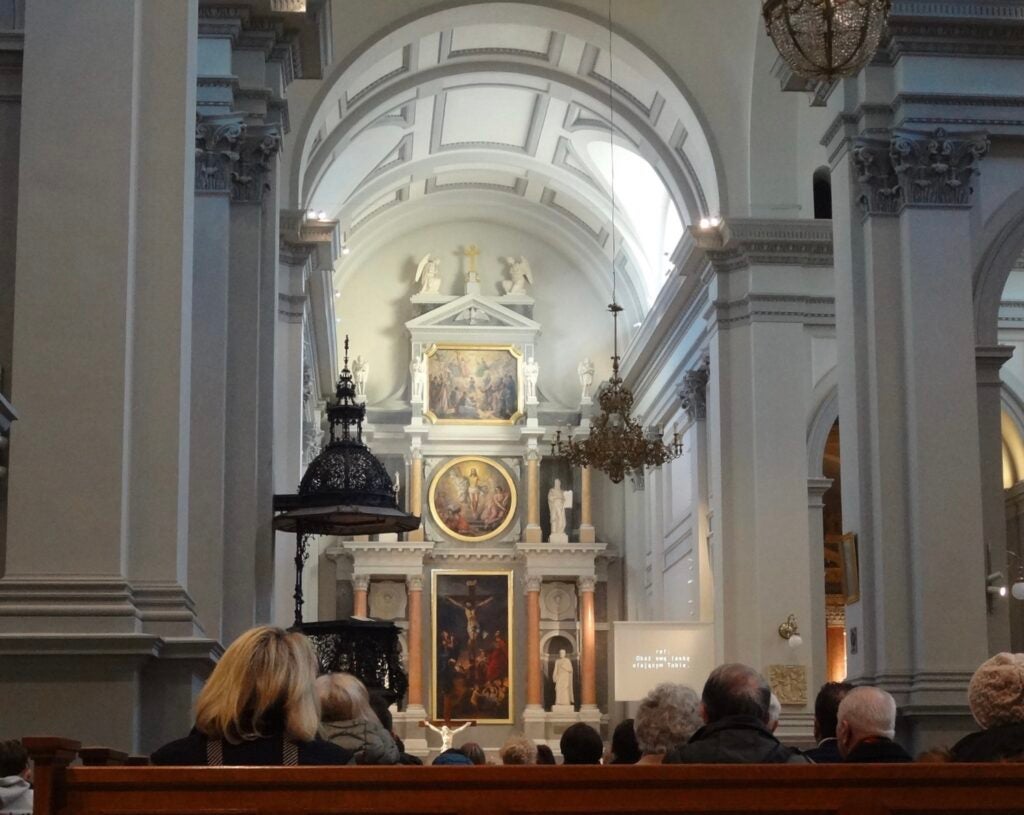
All Saints Church is a Roman Catholic church in Warsaw. We attended Holy Mass here– completely in Polish, and a first-time experience for many. Photo by Avanthika Suryadevara (H‘27).
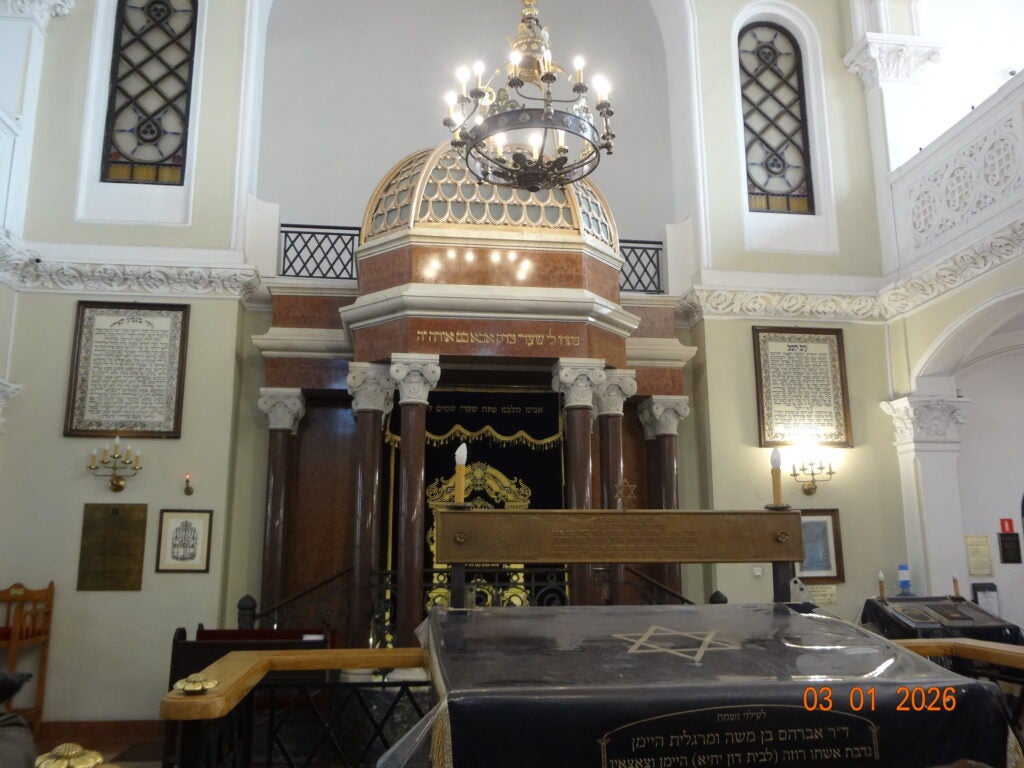
Nożyk Synagogue, the only remaining prewar synagogue in Warsaw. Here, we met the Chief Rabbi of Poland, Rabbi Michael Schudrich, and attended Purim services. Photo by Avanthika Suryadevara (H‘27).
Avanthika: We learned that in the Warsaw ghetto, All Saints Church stood as one of the only functioning Christian spaces inside the ghetto, becoming a place of refuge across faith lines. Hearing how Fr. Marceli Godlewski, a Polish priest living inside the Warsaw ghetto, risked his life to shelter and save Jewish residents during the German occupation of Poland, reminded me of how powerful interfaith solidarity can be.
Ella: More than just seeing these religious sites, being able to interact with the communities of each was amazing. We were able to attend a Purim celebration and a Holy Mass, which made it a lot easier to reconcile the history we learned about with the current flourishing of these religious communities. We were able to talk to the Chief Rabbi of Poland, Michael Schudrich, who played a central role in the Jewish revival in Poland, and Fr. Manfred Deselaers, Ph.D., a Catholic priest and theologian known for his work in Polish-German and Christian-Jewish dialogue, which allowed us to learn more about faith traditions and how communities moved past tragic events.
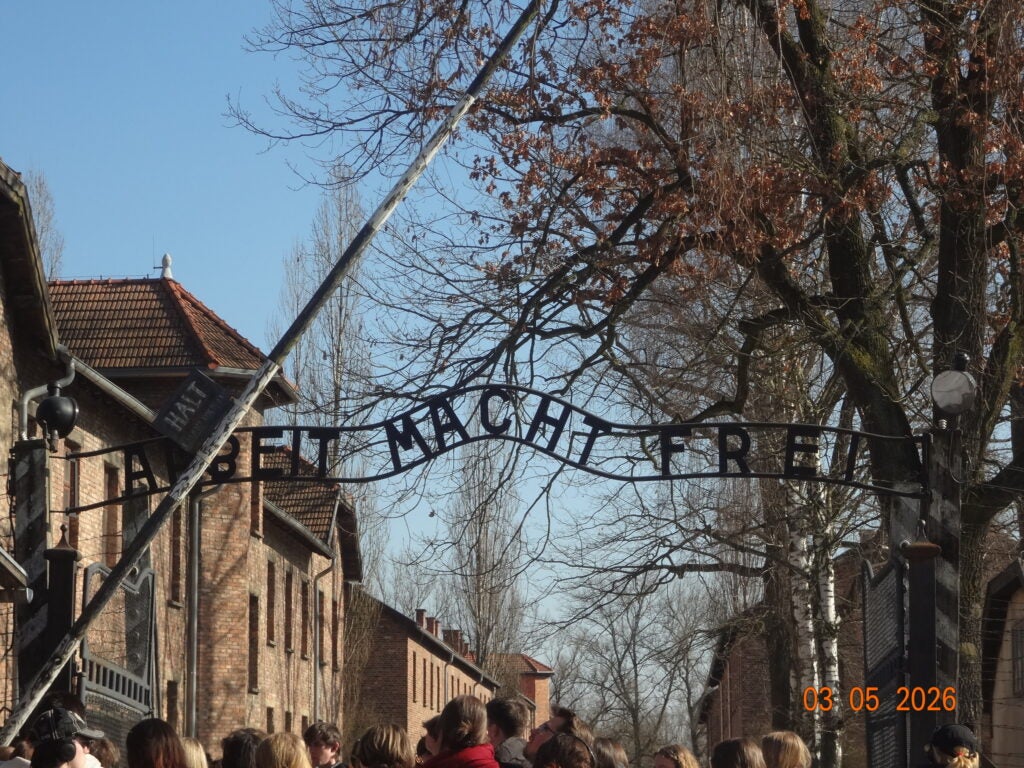
At the gates of Auschwitz I. Photo by Avanthika Suryadevara (H‘27).
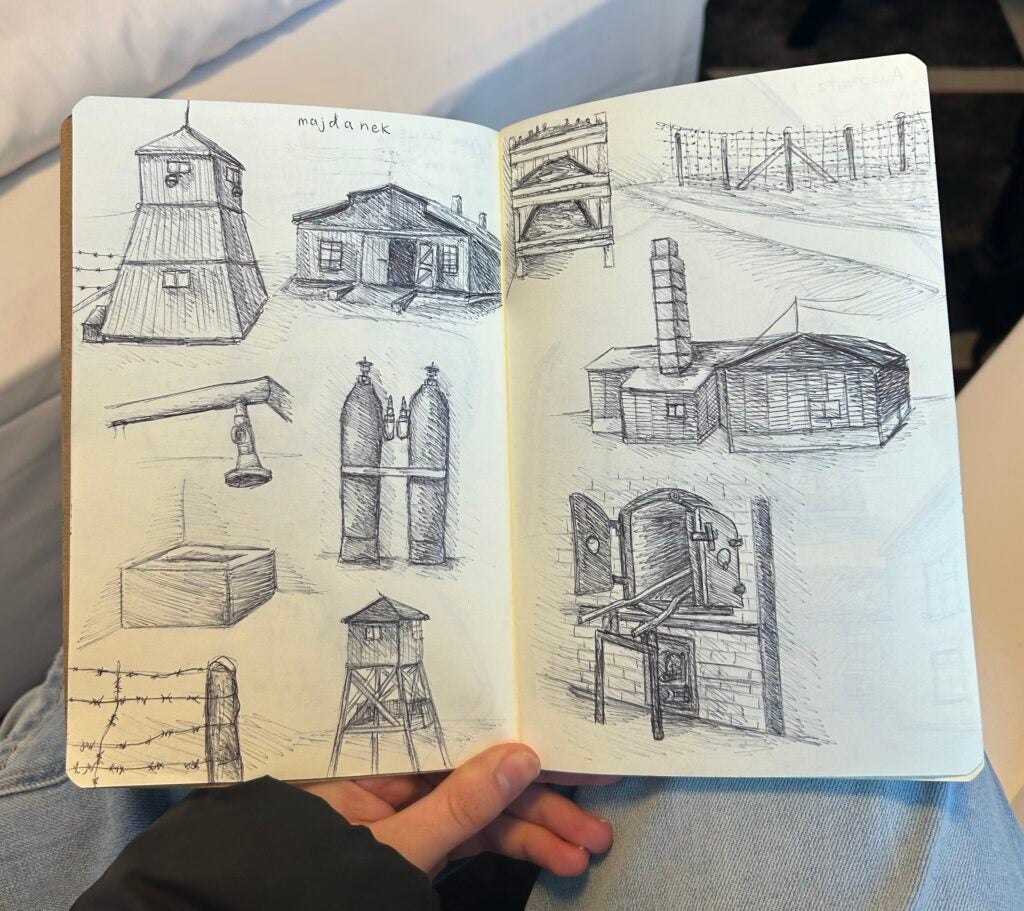
Drawings done inside the Majdanek concentration camp, by Ella Montano (C‘28).
Avanthika: What struck me at the first concentration camp we went to, Majdanek, is the path we took through the camp. We started where people were first brought into the camp and registered, went through the barracks, and ended at the crematorium and mausoleum. This is the life someone was forced to live 80 years ago. They never got to leave. And we did. I was repeatedly struck with this sentiment, again at Bełżec and at Auschwitz. At Auschwitz I, the main concentration camp at the Auschwitz-Birkenau State Museum, we saw a video of Jewish life before the war—its vibrancy, joy, love, and community. As a storyteller, I was heartbroken at how many stories we never got to hear, how many lives were unjustly taken.
Ella: As an artist, the best way I can think of to memorialize an experience is to draw. So, when we visited Majdanek and Auschwitz concentration and extermination camps, I tried to capture my perspective through pen drawings. By doing this, it forced me to think about my perception of memory and how it is preserved, especially after tragic events such as these. I found that this was a great way to process emotions in emotionally heavy places like concentration camps.
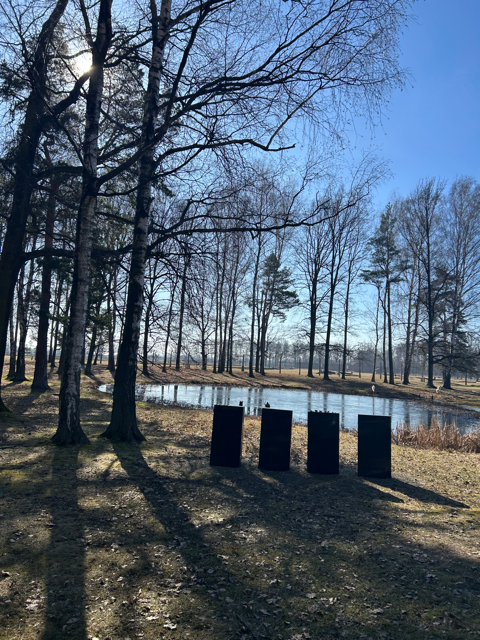
This is the site where historians believe ashes from the crematoria were deposited. Four gravestones are inscribed in different languages for the Polish, Jewish, and Romani/Sinti lives lost. Also visible are stones placed on top of the gravestones, a Jewish tradition and act of remembrance. Photo by Ella Montano (C‘28).
Avanthika: At the end of each visit to a concentration or extermination camp, we honored the dead with the Jewish Mourner’s Kaddish and Christian prayers offered by students. I had never experienced either before, so it was a meaningful learning moment in how these two faiths approach remembrance. I was reminded of our diversity—and how we can share the same emotions while expressing and processing them in different ways.
Ella: Standing on the ground that serves as a mass grave for a lot of victims was very emotional and overwhelming. The suffering was so immense, and being in the physical space was a heavy experience. We were given time to reflect and to perform ceremonies to honor the dead, which was a meaningful way to bring together diverse faith traditions and the individual experiences of each student. I really appreciated the opportunity to hear other students share a personal prayer or poem.
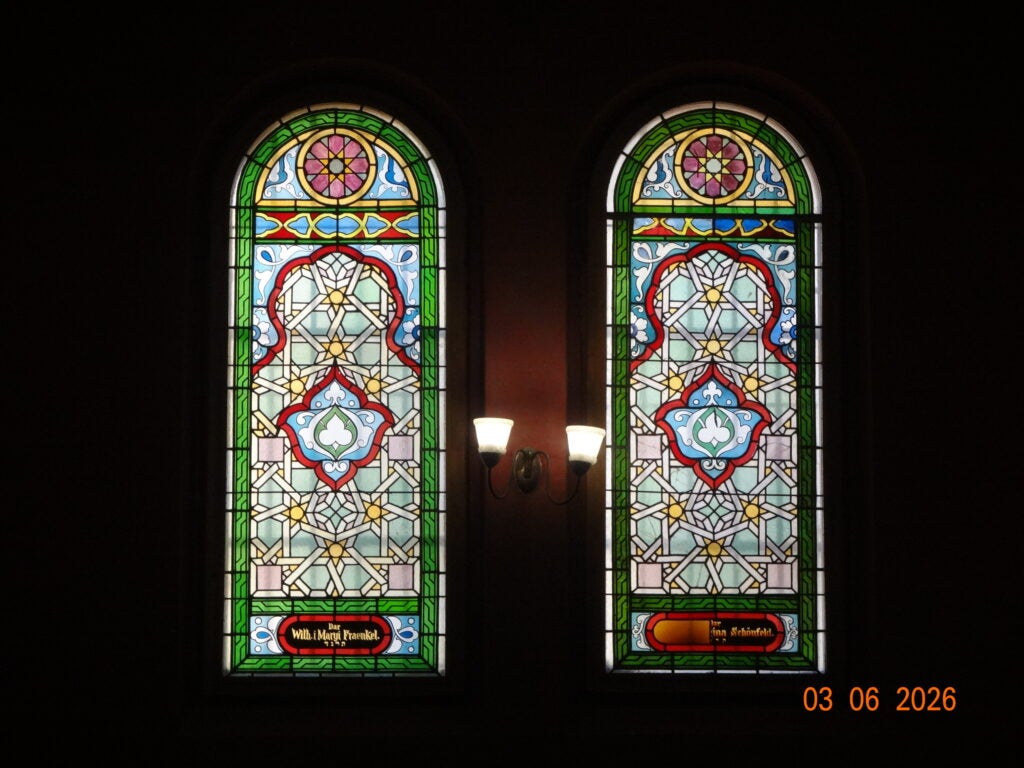
Tempel Synagogue in Kraków, where we saw the only surviving stained glass windows of a synagogue in all of Poland. Photo by Avanthika Suryadevara (H‘27).
Avanthika: When our tour guide told us that these stained glass windows in Kraków were the only remaining ones from prewar synagogues, I was struck with a sense of loss. So much was taken—culture, stories, lives. But some of it still survives. While we can’t change and should never forget the number of people murdered, we can change what is lost into what is remembered. We hope to continue to tell their stories.
Ella: By the time we reached Kraków, it had been quite a heavy and emotionally taxing trip, so being able to learn about the current Jewish community in Poland and their plans for the future was refreshing. It was meaningful to see how much they have grown and how they are continuing to grow. Their ability to put their hardships in the past to focus on hope for the future was incredibly inspiring. While meeting the current communities, we also saw old synagogues, which are proof of the Jewish community’s ability to endure.
Avanthika Suryadevara (H‘27) is studying Health Care Management and Policy on the pre-med track.
Ella Montano (C‘28) is studying Mathematics and Economics.
- Tagged
- Magis