Magis Immersion Seminar: St. Paul’s Letters in Greece
By Elle Marinello (C‘28)
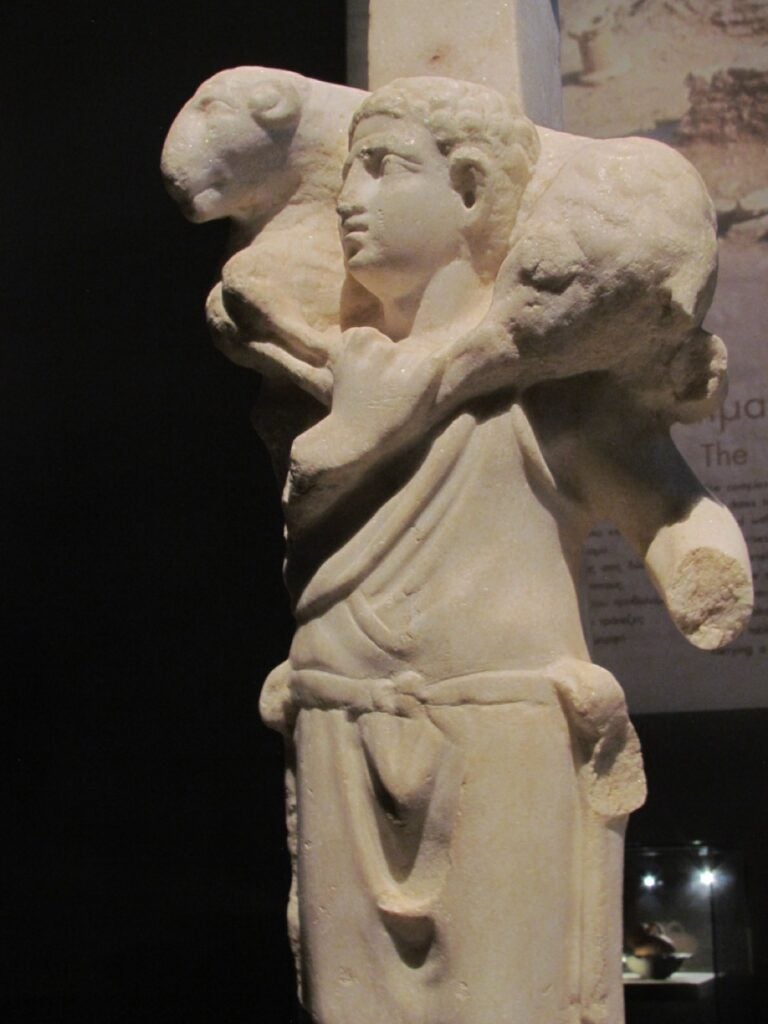
Byzantine Museum in Thessaloniki, Statue of a Young Boy Carrying a Sacrificial Lamb. Photo by Elle Marinello (C‘28).
This photo was from the first day of the trip. After getting up very early in the morning after a long day of travel, we started the day in the Byzantine Museum in Thessaloniki. While there, we saw a statue of a young boy carrying a lamb. We were told that this image was originally considered reverent and important in pagan religion. However, as Christianity became the dominant religion of the area, the image eventually became associated with Jesus as the Shepherd.
The transformation of this image from a pagan symbol to one associated with Christ reminded me of Paul’s letters. Paul was often writing to pagan communities who would have known these images and recognized their significance. Seeing these images and motifs adapted and changed to fit this new faith shows Paul’s ministry at work. He understood that people lived in their existing worlds and cities. Instead of forcing them to first convert to Judaism, then to Jesus as Messiah, Paul met people as they were and adapted to them, much like this image was adapted over time.
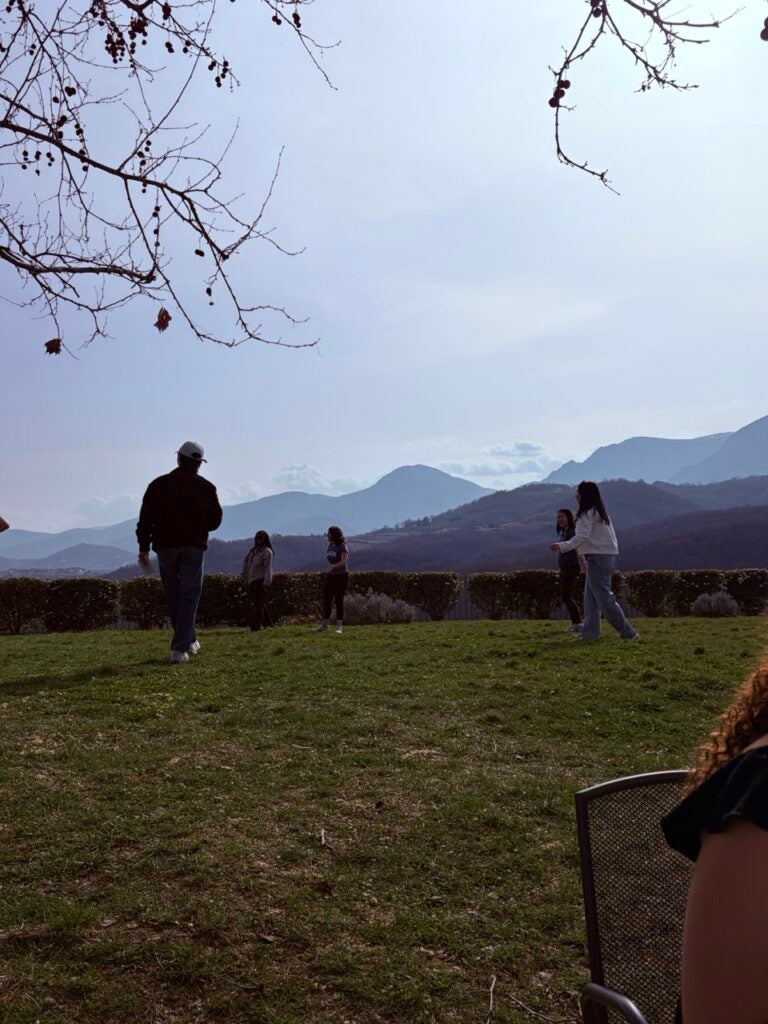
Kir-Yianni Winery, Yiannakohori; The Group Taking a Break in the Mountains. From left to right, Jeremy Suzuki, Malar Bala, Camille Deschapelles, Sophianne Leung, and Elizabeth Kim. Photo by Elle Marinello (C‘28).
This photo is from the fourth day of our trip, and one of our longest travel days, as we left Thessaloniki and headed to Litochoro. On the way, we stopped at a winery, and afterwards, while waiting to get back on the bus, some members of the group chatted while others found a ball and started an impromptu soccer game. I took this picture as I watched them playing together.
As I did, I was reminded of what we had seen the previous day in Philippi. This was one of Paul’s poorest communities, yet its members consistently gave what they could to support and help him in his ministry. In his letters to them, Paul often emphasized friendship and community, drawing on ideas of togetherness that would have been familiar to philosophers of the time. I felt it fitting that the day after visiting Phillipi was the day our group really started to come together, feeling open and more comfortable with one another. In a way, it felt like we carried Paul’s message with us. It is why I included this photo, even if the moment itself may seem simple.
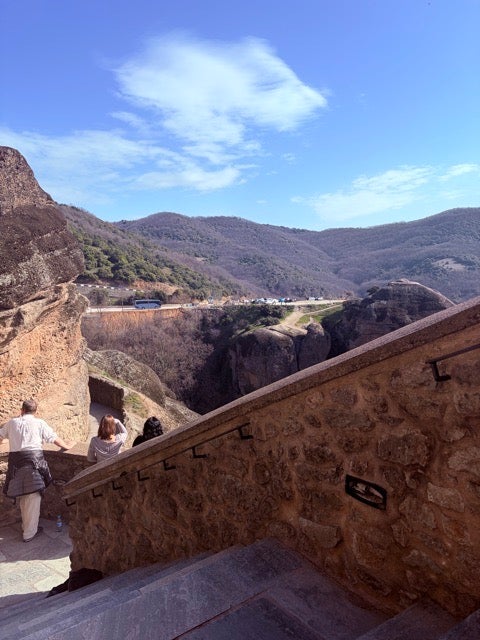
Top of the Steps of The Monastery of Varlaam, Meteora. From left to right are Fr. Campbell, S.J., Susannah Masson, and Camille Deschapelles. Photo by Elle Marinello (C‘28)
This photo was taken outside the entrance of The Monastery of Varlaam. After a short hike and a very large flight of stairs, a few of us reached the entrance and realized how far ahead we were of the rest of the group. We sat on the upper steps in front of the entrance, talking about our favorite parts of the trip so far, while waiting for the others to arrive.
What we did not realize at the time was that some of our classmates had stopped along the way to jot down their experiences in their journals. This moment reminded me of a poem that Fr. Bill Campbell, S.J., the rector of the Georgetown Jesuits, read to us before the trip started. The poem reflects on choosing the pilgrim’s sandals over the chariot. The chariot is fast and easy, but the pilgrims’sandals allow the traveler to carry meaning with them and to absorb the world more fully.
Sitting at the top of the stairs gave me time to reflect on that idea. It reminded me that we are all pilgrims following in the footsteps of St. Paul. I realized that I should not feel impatient when my classmates take time to absorb these experiences differently. Instead, I should appreciate their reflections and learn from them, recognizing we are on the same journey even if we experience it at different paces.
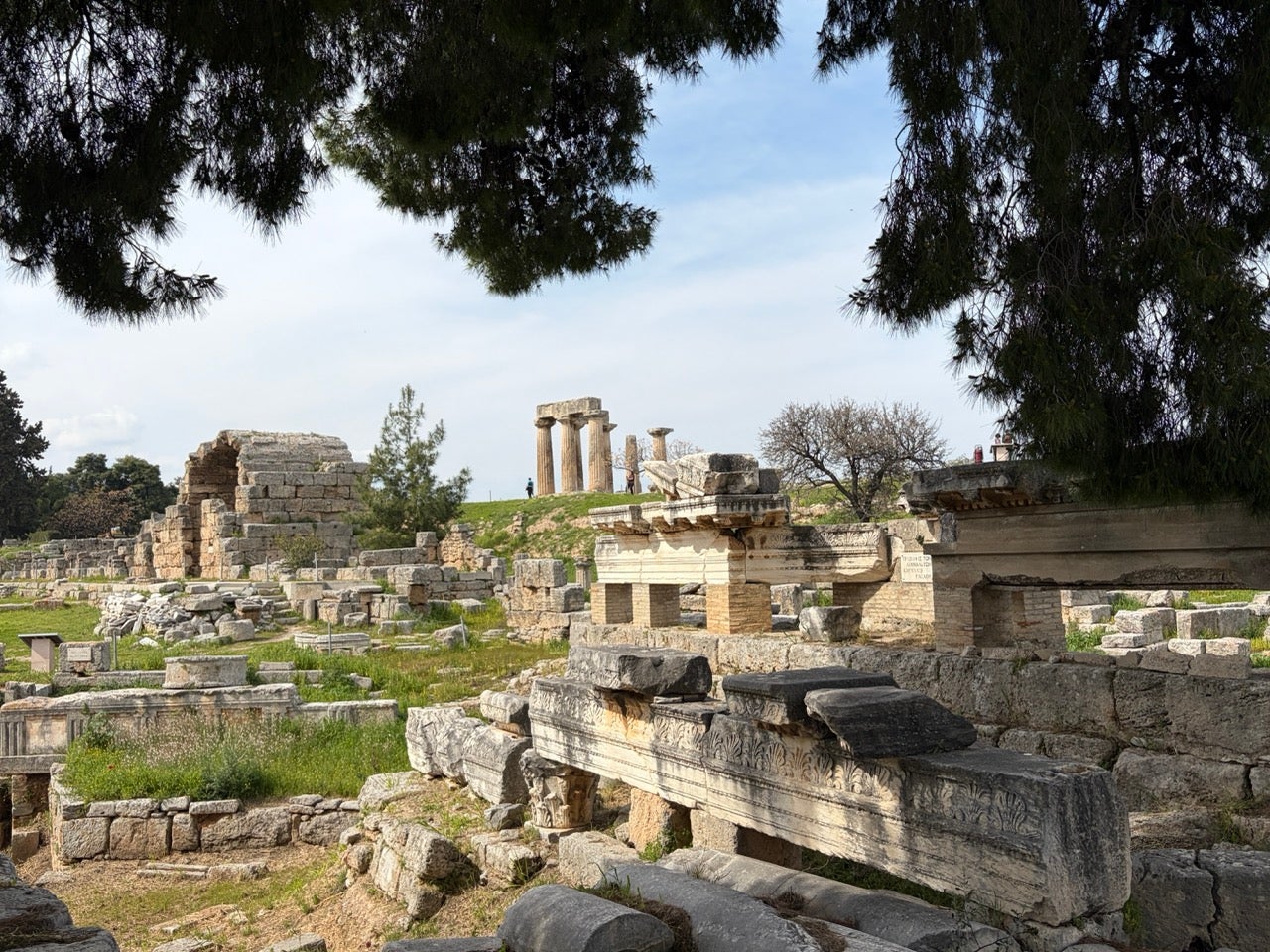
Ancient Corinth, Corinth: A Wide View of the City. Photo by Elle Marinello (C‘28).
Corinth is a city that is important not only to the history of Greece, with its vibrant city culture and notable temples, such as the Temple of Aphrodite, but also because of the community Paul founded there. Corinth was very different from Thessaloniki or Philippi. It was a city of wealth, where some individuals sought to fund Paul’s journey, while also attempting to exert influence over lower-status members of the community.
However, Paul refused their money and challenged them in his letters by defending the lower-status people. This created tension and hostility toward him within the community. Standing in this city, which plays a dynamic and important role in Paul’s letters, I was reminded to something Fr. Campbell S.J., shared at Mass on the first Sunday of the trip: that we should dip into our imaginations in these places and not only look at the ruins around us but imagine these places as Paul knew them to grasp their significance. It was in Corinth that I fully understood what he meant. As I looked at the ruins around me and the new city below, I felt like I understood why Paul chose this place. I could better imagine the impact of his ministry and the challenges he faced, especially with the upper-class people and his appearance at the Bema.
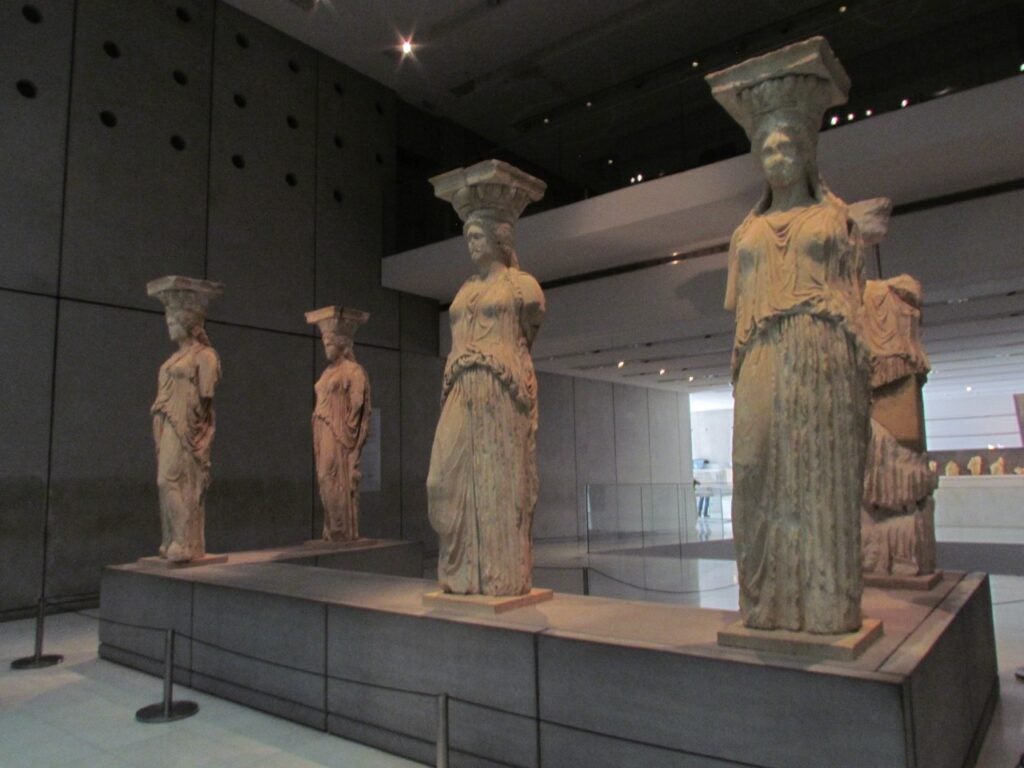
The Acropolis Museum, Athens; The Incomplete Caryatids of the Erechtheion. Photo by Elle Marinello (C‘28).
Lastly, I chose a photo of the Caryatids from the Acropolis Museum because of how deeply they moved me, especially on the final day of our trip. These statues once served as pillars on the Erechtheion, but one was taken and now resides in the British Museum, separated from her sisters.
I included this photo, even though Paul did not preach on the Acropolis itself but on the Areopagus, because it reminded me of what Paul sought to do with his ministry. Throughout his letters, Paul sought to keep his communities strong in their faith, but also in their friendship and sense of brotherhood. Even when members of the community put one another down, Paul did not abandon them. Instead, he remained committed to addressing their conflicts and restoring unity. Similarly, the Greeks have not given up on reuniting the Caryatids. In the museum, a space has been left for the missing statue. She has not been forgotten, and there is still hope that one day she will return. While this story is not directly related to Paul’s letters, this display reminded me of the way Paul saw his communities and cared for them, how he addressed their struggles and remained committed to them without giving up.
Elle Marinello (C‘28) is studying Classical Studies and English.
- Tagged
- Magis